

■ Certification Overview
In Korea, medical devices are regulated by the Ministry of Food and Drug Safety (MFDS). The legal framework of this system is based on the Medical Devices Act, the Enforcement Decree of the Medical Devices Act, and the Enforcement Rules of the Medical Devices Act. There are three types of marketing authorizations granted by the MFDS. Medical devices with minimal potential risk require pre-market notification. Higher risk classes require pre-market certification or pre-market authorization.
In order to obtain licensing approval in Korea, you must obtain both device approval and quality system certifications specified in the Medical Device Manufacturing and Quality Management Standard (similar to ISO 13485:2016), known as the Korean Good Manufacturing Practice (KGMP).
■ Regulatory Bodies & Basic Information
| Regulatory Body | Ministry of Food and Drug Safety (MFDS) |
| Certification Body | Ministry of Food and Drug Safety (MFDS): Overseeing the licensing and follow-up management of high-risk (Class 3 and 4) medical devices |
| Korea Medical Device Safety Information Service (NIDS): Certification of Class 2 medical devices and entrustment of Class 1 notification repair work |
|
| Language | Korea |
■ Medical Device Classification
| Class | Risk | Example | |
|---|---|---|---|
| Class 1 | Very Low risk | • Medical compression stockings • Manual wheelchair • Medical gloves • Dental implant instruments |  Medical gloves |
| Class 2 | Low risk | • Electric wheelchair • Digital thermometer • Hearing aid • Personal combination stimulator | 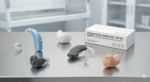 Hearing aid |
| Class 3 | High risk | • Artificial Joints (Hip/Knee) • Hemodialysis Machine • Automated External Defibrillator (AED) • Artificial Heart Valve |  |
| Class 4 | Very High risk | • Pacemaker • Implantable drug infusion device • Artificial cardiopulmonary device • Stent (for cardiovascular) |  |
The MFDS uses a system that classifies items into four levels based on the risk to the human body, classifying them into Grades 1, 2, 3, and 4 as the risk level increases. Manufacturers of Grade 2, 3, and 4 devices must obtain KGMP certification before device registration is issued.
■ Certification Process
- Designation of local permit holder
- Medical device classification
- Technical documentation and testing
- KGMP certification
- Submission and Review
- Approval and Registration
■ Required Documents
| Administrative Information | • Local Representative Appointment: A Power of Attorney (POA) in which the foreign manufacturer officially designates the Korean importer (License Holder) or legal representative. • Application for Import/Manufacturing Business License: Corporate license documents for domestic business operations. • Certificate of Free Sale (CFS): Document proving legal sales issued by the government of the country of manufacture (If the original is in a foreign language, verification of notarization and Apostille requirements is mandatory). |
| Device Description & Technical Documentation | • Technical File (STED): Key documents describing the operating principle, raw materials (ingredients and quantities), manufacturing method, performance, intended use, storage method, and shelf life, etc. (The final version submitted to the Ministry of Food and Drug Safety must be written entirely in Korean) • Substantial Equivalence Comparison: Data for comparative analysis with previously approved products |
| Labeling & Packaging | • Proposed Korean Labeling: Draft label for the device body and outer packaging reflecting mandatory information under the Medical Devices Act (importer name, license number, manufacturing number, date of manufacture, etc.) • Instructions for Use (IFU): Korean manual and technical guidelines for domestic users (medical staff and patients) |
| Quality Management System | • Korean Good Manufacturing Practice (K-GMP) Certificate: Certificate of Conformity based on on-site inspection or document review of the quality system at an overseas manufacturing facility (Mandatory requirement for Class 2, Class 3, and Class 4 medical devices; validity period management is mandatory) |
| Electrical Safety & EMC | • Electrical Safety Test Report: Test report in accordance with the latest accredited standards, such as IEC 60601-1 (Original English text accepted) • Electromagnetic Compatibility Test Report: Electromagnetic safety test report in accordance with IEC 60601-1-2, etc. (Original English text accepted) |
| Biocompatibility & Sterility | • Biocompatibility Evaluation Report: Test reports for cytotoxicity, sensitization, irritation, etc., based on ISO 10993. • Sterility & Packaging Validation: For sterile products, processing, residue testing, and sterile shelf life verification reports in accordance with ISO 11135 or ISO 11137, etc. |
| Software & Cybersecurity | • Software Validation Documentation: For standalone software (SaMD) or software-embedded devices, verification and validation (V&V) reports according to the lifecycle (ISO 62304). • Cybersecurity Data: If network connectivity is present, documents regarding security vulnerability analysis, threat modeling, and response plans. |
| Performance & Clinical Data | • Bench Testing / Performance Test Report: A report verifying the product’s unique physical, chemical, and mechanical performance specifications. • Clinical Evidence: Domestic or international clinical trial reports confirming the product’s safety and efficacy, or clinical papers within the scope recognized by the Ministry of Food and Drug Safety (Mandatory for Class 3, Class 4, and newly developed medical devices). |
■ Validity Period and Maintenance
- Item Approval and Notification: No Expiration Date
- Quality System
- K-GMP Conformity Certificate: 4 years